Rienzi Finally Reaches Bayreuth — as an Election Drama
The Guardian
Bayreuth's board has kept Rienzi off its stage for a century and a half for good reason: the complete manuscript passed into Adolf Hitler's hands and never resurfaced, leaving no authoritative version of Wagner's longest opera, and its status as the Fuhrer's favorite score made it the one work the festival could not touch without answering for it. That embargo ended this week, when the 150th-anniversary season opened with a Rienzi built for 2026 rather than fourteenth-century Rome.
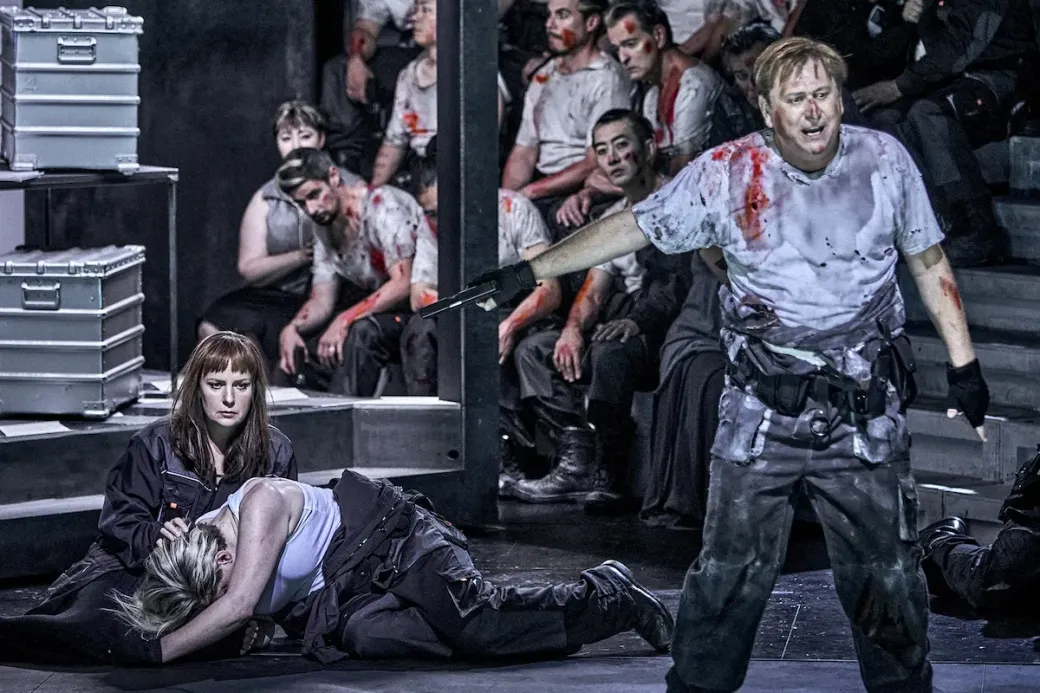
Directors Alexandra Szemeredy and Magdolna Parditka transplant the plot's rise and fall of a populist tribune into an abstract near-future thick with smartphones, live video feeds labeled 'live from the Capitol,' and placards reading 'lock him up' and 'bringing Rome back.' The staging wants credit, implicitly, for a capitalism critique: spectacle politics as a symptom of the market. That claim is shakier than it looks. What the production actually stages is a figure who rises by claiming to stand above faction, speaking for 'the people' through spectacle rather than through any coherent program -- a pattern that shows up whenever factional conflict stalls into deadlock and a vacuum opens for personality and stagecraft to substitute for argument, market economy or no. That kind of opportunist isn't a product of commerce; he's a symptom of political paralysis, a distinction the smartphones and live feeds blur every time they get read as an indictment of capitalism rather than of gridlock.
It also skips past an inconvenient history. The system that preceded the market wasn't obviously kinder to musicians: Bach was a salaried servant of the Leipzig town council, and Haydn wore livery in the Esterhazy household for three decades. Patronage bought funding and stability at the cost of literal bondage. The market that replaced it gave musicians freedom and precarity in roughly equal measure -- and yet the thing most working musicians chase today, 'career' in the sense of visibility, reputation, brand, is itself a market invention. No patron ever offered a court composer a career; he offered a post. Wagner is not an innocent bystander to that contradiction; he is its clearest specimen. The same man who fought beside Bakunin on the Dresden barricades in 1849, and who wrote Art and Revolution that same year to argue commerce had degraded art into a commodity, spent the rest of his career as the most successfully self-mythologized brand in nineteenth-century music -- bankrolled by a besotted king, then selling Bayreuth itself as a pilgrimage. He never resolved that tension. He built a festival out of not resolving it.
Conductor Nathalie Stutzmann, leading the pit in a role historically reserved for men on this stage, drew a performance that alternated chamber-scaled intimacy with the score's more bombastic marches — no small feat, given that Rienzi's reputation for structural bloat (well over four hours, in a work Wagner himself later disowned as juvenilia) makes pacing the real technical problem a conductor inherits here, more than any interpretive one. Andreas Schager sang the title role with the clarion, high-wattage tenor that has made him Bayreuth's default heavy-lifter in recent seasons; the more striking performance, by most accounts, came from Jennifer Holloway, recast as Adriano — reimagined here not as Wagner's original trouser role but as an openly gay woman — whose singing carried an emotional register the surrounding production's crowded visual noise couldn't quite match.
Whatever the staging's politics settle out to mean, the more durable story is a budgetary one. Bayreuth had originally planned to pair Rienzi's premiere with stagings of all ten other canonical Wagner operas across the anniversary season, finally closing a gap the festival spent a century and a half maintaining on purpose. Money intervened: Tannhauser, Lohengrin, Tristan und Isolde and Die Meistersinger were all cut before rehearsals began, leaving Rienzi to open alongside just the Ring, Der Fliegende Hollander and Parsifal -- seven operas instead of eleven. The festival that spent 150 years refusing to stage its most politically radioactive opera on principle now can't quite afford the completist gesture either.
Sources