The Bayreuth Festival Institutionalizes Populism for its 150th Anniversary
DPA (via Onetz)
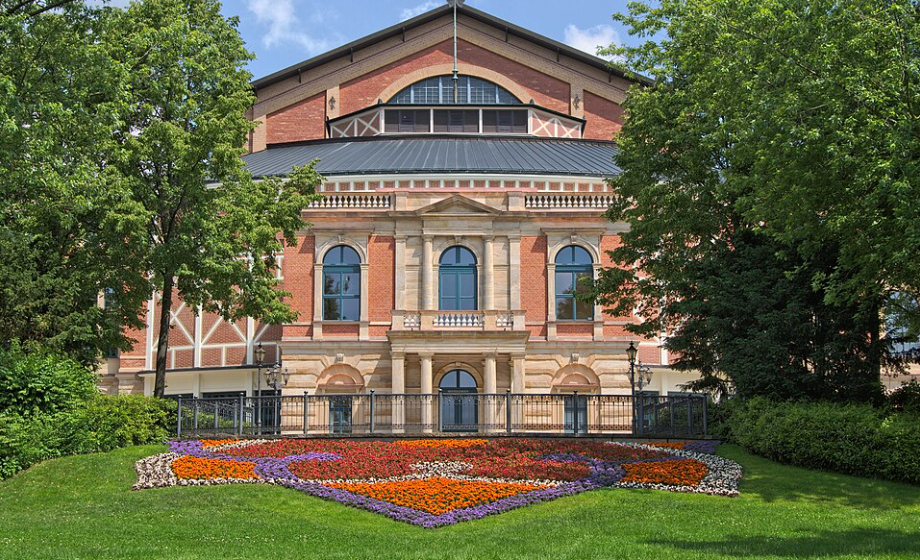
On August 2nd, up to 1,000 guests will gather backstage at the Bayreuth Festspielhaus for a DJ set by Frans Zimmer, known professionally as Alle Farben, built from motifs drawn out of Wagner's operas. Intendantin Katharina Wagner is unambiguous about the intent: "We're actually mixing electronic sounds with Wagner motifs," she said, calling it a "unique event" designed to "make people curious who normally don't count among our regular audience" (DPA/Onetz). Zimmer, who has worked with classical material before but never with Wagner, called the booking "a very short-notice undertaking" and said he hopes to "build a bridge to Wagner" for a crowd that wouldn't otherwise cross the festival's threshold.
The party did not appear from nowhere. Bayreuth's 150th-anniversary programme was scaled back from eleven Wagner operas to seven months before the DJ set was announced, a reduction the festival attributed to rising personnel costs it could not cover despite a self-financing rate above 55 percent (Opera Online). Tannhäuser, Lohengrin, Tristan und Isolde, and Die Meistersinger were all cut. Rienzi — the opera Wagner himself excluded from the Bayreuth canon — was added instead, receiving its first-ever staging at the Festspielhaus this year. An institution too constrained to mount its own core repertoire found room, in the same season, for an electronic set built around that repertoire's motifs.
It also found the anniversary harder to manage than its programming alone suggests. A memorial event for Jewish musicians persecuted under National Socialism was cancelled and then reinstated only after public protest, led by the scheduled speaker, Michel Friedman (Slippedisc). Both the memorial and the DJ party required separate sign-off from the Bayreuth Stiftungsrat — an unusual amount of oversight for what the festival is otherwise calling a straightforward crossover booking.
Whether this is outside influence bending an institution or an institution evolving on its own terms depends on which precedent gets weighted. Bayreuth has bent before: Wieland Wagner's postwar stagings, stripped of nationalist iconography, were themselves a controversial reinvention forced by circumstance rather than pure aesthetic conviction. Read that way, a DJ set aimed at people who "don't count among our regular audience" is continuous with a festival that has repeatedly adjusted itself to survive. Read the other way, it is a canon-holding institution outsourcing its authority to draw a crowd it can no longer draw on the strength of Wagner alone.
What isn't yet available is an answer from the audience. The event is still two weeks off; German coverage so far (Onetz, Abendzeitung München, Main-Echo) has been announcement, not review, and none of it registers the kind of visible backlash that met the memorial cancellation. Call this what it is: an institution's own bet on its reasoning, not yet a verdict.
🔒 The full analysis — including the reaction threads it triggered and the case for why institutional health and artistic purity aren't the same axis — is available to Stradisphere Insider members. Subscribe to unlock it: https://www.stradispheremusic.com/member-site-homepage-1-2-1