The Dodecaphonic Rigor of Elisabeth Lutyens
Crescendo Magazine
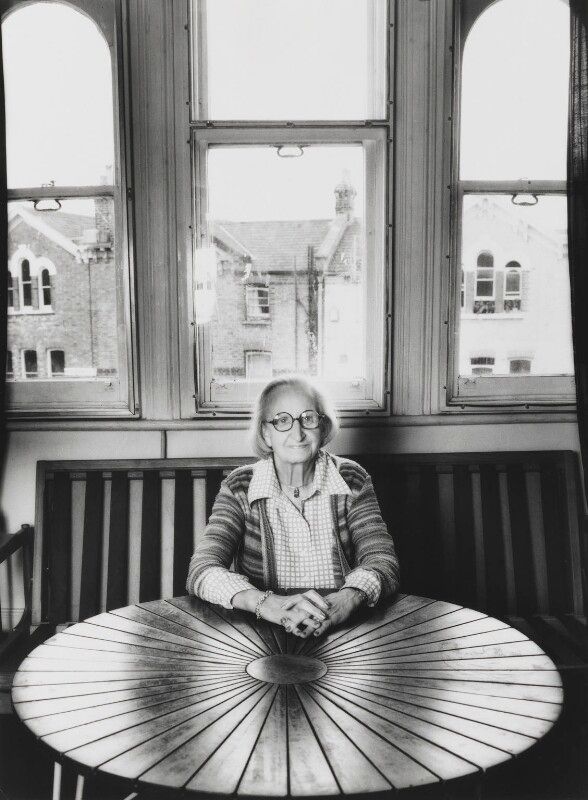
She signed her letters and answered to "Betty" her entire life, which makes it stranger that history remembers her, when it remembers her at all, by a jeering nickname. Elisabeth Lutyens (1906–1983) wrote the first British serialist work in 1939 — before Humphrey Searle, before any of the other national pioneers of twelve-tone composition — and died with a catalogue running to 160 opus numbers. No Lutyens piece is currently programmed at a single French festival. Crescendo Magazine's summer series on composers "official history didn't retain" put her fourth in line, and the honest answer to why she needed rediscovering at all is that nothing was ever lost. The scores survived. Britain just didn't play them.
She was born into a household split between two kinds of certainty. Her father was Sir Edwin Lutyens, the most celebrated architect of the British Empire — the man who designed New Delhi's government quarter and the Cenotaph on Whitehall, monuments built for an empire that still believed in itself. Her mother, Lady Emily Lytton, was an aristocrat who converted first to theosophy and then to the teachings of Jiddu Krishnamurti — a household of monuments on one side and revelation on the other. Betty decided she'd be a composer at nine. She trained at the École Normale de Musique in Paris in 1922, discovering Debussy, then entered London's Royal College of Music in 1926 to study composition under Harold Darke . There, in a small circle of students committed to modern music, she found the scores of Britten — and, decisively, of Webern.
Her Chamber Concerto No. 1, Op. 8/1 , completed in 1939, is unanimously recognized as the first British serial work. She wrote it in near-total isolation from European currents — she never attended the Darmstadt summer courses that shaped a generation of continental serialists, building her technique instead through solitary reading of Schoenberg and Webern. What resulted was a rigorous chromaticism inside a genuinely lyrical, narrative sensibility — discipline that never curdled into dogma.
Her life outran her catalogue for drama. She married the baritone Ian Glennie in 1933 and had three children, including twins; five years later she left him for Edward Clark , who soon lost his own BBC post, leaving Lutyens the family's main earner into the late 1950s. She wrote to order — for radio, advertising, and above all film, becoming the first British woman composer to score a feature. She left roughly thirty film scores, split between Hammer and its rival Amicus, work that sharpened her orchestration to a fearsome precision and left her, by her own account, exhausted and bitter — a bitterness alcohol didn't touch.
The postwar concert scores are where the nerve is. O Saisons, O Châteaux (1946) sets Rimbaud for soprano and small ensemble with an almost unaccountable vocal beauty. The Excerpta Tractati Logico-Philosophici (1952), an a cappella motet on Wittgenstein's Tractatus , is inflexibly rigorous. Quincunx (1959) is a large-orchestra summit; four operas followed, including Infidelio, written in 1954 but not staged until 1973 — nineteen years between composition and hearing, which is its own small monument to the neglect this piece is trying to correct.
Lutyens didn't help her own cause. She loathed Elgar and the Edwardian symphonists out loud, dismissed Vaughan Williams's pastoralism as "cowpat music" , and called out what she saw as provincialism dressed as a national school. The establishment — Britten included — kept its distance in return, and commissions thinned. But she had at least one moment of vindication she liked to tell on herself: after dedicating her Hommage à Igor Stravinsky (1956) to the composer, she claimed that at a 1959 BBC rehearsal in Maida Vale, Stravinsky stood up, crossed the room, and kissed her on sight, having been sent the score of her 6 Tempi — "That is the music I like!" Recognized by the biggest name in the room, held at arm's length by her own.
The reasons for the erasure compound rather than reduce to one cause: a mid-century Britain suspicious of serialism as continental import; a strictly male new-music establishment that treated a woman composer, let alone a hard-drinking, sharp-tongued one with four children, as a social aberration as much as an aesthetic one; a career spent outside any conservatory post, so that she trained no school of disciples to carry the catalogue after her; a horror-film sideline that calcified into her public identity ahead of Quincunx or The Numbered; and, until very recently, a discography limited to scattered Lyrita and Argo pressings. NMC, Resonus, and Métier have only started the real archival work in the past two decades — nothing on the scale of what ECM did for Kurtág, and nothing at all, still, in French: no monograph, no profile in the major reviews, no recent concert in France or French-speaking Belgium.