The Three Choirs Festival Maintains its English Choral Hegemony
Bachtrack
The Three Choirs Festival has been meeting in some combination of Gloucester, Hereford, and Worcester cathedrals since roughly 1715, which makes it not merely older than Bayreuth or Salzburg but older than most of the concert halls that would eventually compete with it; it was founded, in fact, as a charity for the widows and orphans of clergy in the three dioceses, and only picked up its now-official name in Gloucester in 1838. The 2026 edition opened in Gloucester with a programming logic that treats that inheritance as a living mechanism rather than a museum piece.
Artistic Director Adrian Partington used the cathedral's long reverberation time -- a space that historically dictated the soaring melismatic curves of the Tudor school, the same acoustic that shaped the choral writing of Thomas Tallis and William Byrd three centuries before anyone thought to call it 'atmospheric' -- to anchor a weekend of Elgar, Walton, and the UK premiere of Gavin Higgins's latest large-scale work.
Gloucester Cathedral has done this kind of thing before, with mixed results at the time. On 6 September 1910, Ralph Vaughan Williams stood in that same nave and conducted the premiere of his Fantasia on a Theme by Thomas Tallis, a piece written explicitly to exploit the cathedral's reverberation, splitting the orchestra into separate groups so the sound would arrive from different points in the stone. It was, by most accounts, upstaged that same evening: the program also included the first full performance of Elgar's The Dream of Gerontius, and the only note the local press could spare for the other premiere was that 'Dr Vaughan Williams also conducted a new work.' The cathedral's own organist was blunter, dismissing it afterward as 'a queer, mad work by an odd fellow from Chelsea.' In the audience that night was a seventeen-year-old named Herbert Howells, who would go on to become one of English church music's defining voices and, eventually, a Three Choirs regular in his own right. The festival's whole case for itself is built on that kind of accident: a work too strange for its first night becoming, a century later, one of the most recorded pieces in the English repertoire, performed at a festival that never stopped being willing to risk the next strange thing.
This year's version of that risk is Higgins. The juxtaposition of Walton's jagged syncopation with Higgins's industrial-inflected brass writing extends what regulars here call the 'Cathedral style': the rhythmic grit of the modern pieces arrives hard and is then, almost physically, softened and folded back into the stone 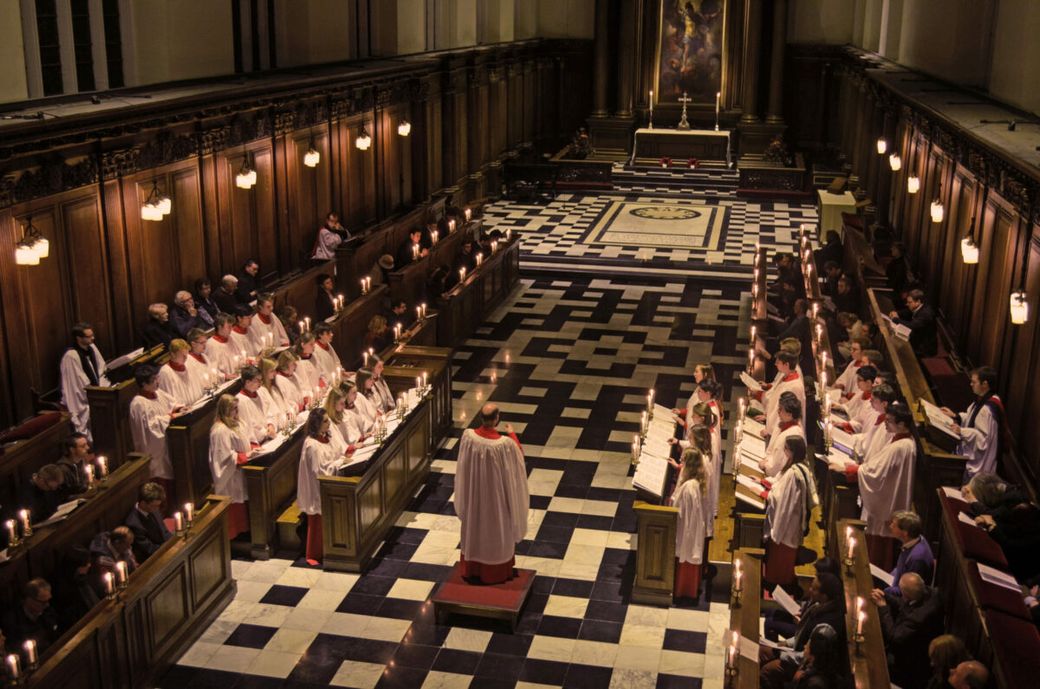 -- the building doing to Higgins roughly what it once did to Vaughan Williams, smoothing a composer's sharper edges into something closer to plainchant, whether he intended it or not.
None of this happens by accident of taste alone. The British arts funding model has spent two decades pivoting toward decentralized, project-based grants that reward exactly the kind of flexible, portable programming the Three Choirs was never built to do. It survives anyway, on the same logic that keeps a single-purpose workshop in business after the department store down the street closes: it does one thing -- build a program around what a Gothic nave's acoustics can do to a chorus -- that no generic concert hall can replicate at any price, and three hundred years of institutional memory in how to do it.