Two rubber-boom opera houses in the Amazon just became UNESCO World Heritage sites
SRF
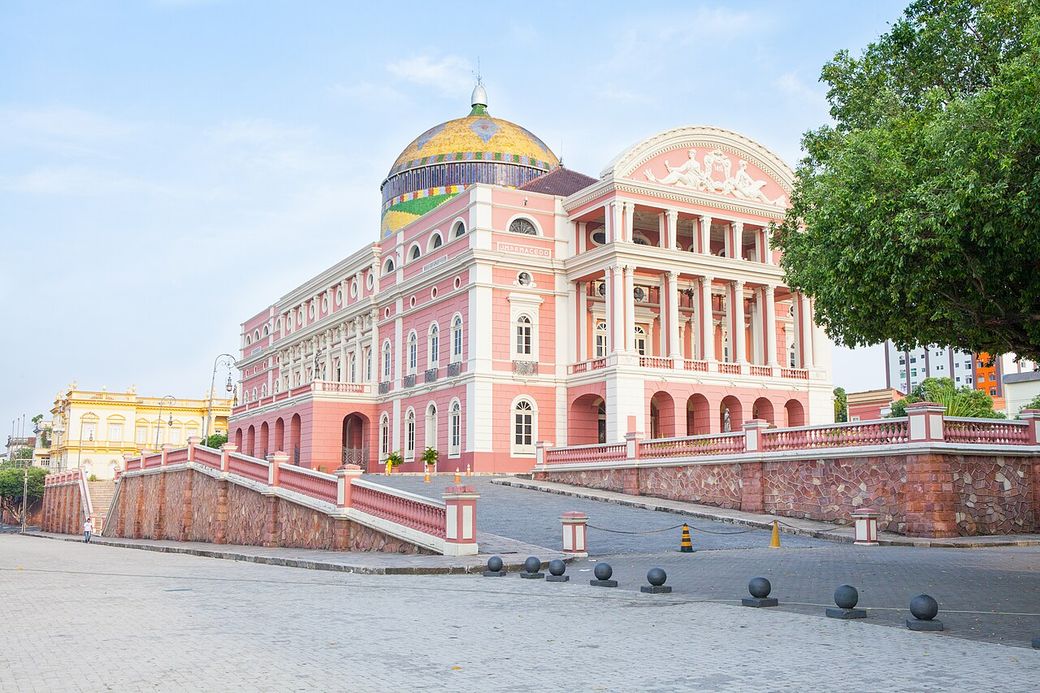
Between 1879 and 1912, the Amazon controlled the world's rubber supply, and two cities in the middle of the rainforest got rich enough to build opera houses. The Theatro da Paz opened first, in Belem in 1878, seating 1,100 and modeled directly on Milan's La Scala; the Teatro Amazonas followed in Manaus in 1896, after twelve years of construction. Both were built entirely on money extracted from wild rubber trees by an industry that had, at most, three more decades to live. Neither city had a functioning railway to the coast -- every piece of the buildings, Italian marble, French stained glass, British ironwork, thousands of tiles for the dome's mosaic, had to come by ship, up the Amazon River from the Atlantic, the same route the rubber itself went out on.
That same river was the only way in for performers, too. European touring opera companies took a transatlantic steamer to the Brazilian coast, then transferred to a second ship for the days-long voyage upriver, arriving in a city whose imported opulence had briefly earned it the nickname "Paris of the tropics." The Teatro Amazonas opened on January 7, 1897, with a real Italian touring company staging Ponchielli's La Gioconda -- not, as a persistent modern legend holds, Enrico Caruso singing Verdi's Ernani. That story was invented for Werner Herzog's 1982 film Fitzcarraldo, which staged a fictional Caruso performance at the theater; no record places him in Manaus at all, and he was 21 and unknown outside Italy when the house opened. Theatro da Paz's real bookings are arguably the better story anyway: home-grown Brazilian opera by Carlos Gomes, and, in 1918, a tour stop by the Russian ballerina Anna Pavlova, arriving well after the rubber economy that built her venue had already collapsed.
That collapse came fast. Brazilian rubber seeds smuggled out to British Malaya in 1876 grew into plantations that could out-produce wild Amazonian trees at a fraction of the cost, and by the 1910s both cities' rubber economies had cratered. The Teatro Amazonas went dark in 1924 -- no touring company could justify the trip once the money that paid for the opera stopped moving through the port. Both houses sat dimmed for decades, revived only by 20th-century government preservation money and, eventually, their own opera festivals.
It's tempting to read this as a familiar twist on the usual story of a place borrowing European opera-house prestige to broadcast local identity. But it runs the other direction: these were never state projects. They were built by a regional merchant elite trying to buy Old World legitimacy with New World money, and they survived the collapse of the very economy that justified them, entirely by accident of good construction and, eventually, government preservation money that arrived generations after the original rubber barons were gone. This month, that whole arc got its formal recognition as UNESCO World Heritage.